Tuesday, November 3, 2009

Congratulations Rhonda Clark!

Our longtime friend Rhonda Clark, Community Food Inititatives Executive Director, recently received a national award for her work on food security in Appalachian Ohio. Below is a copy of the press release. If you see Rhonda about, thank her for all the hard work she has accomplished for our regions food system.

Gardener’s Supply Company, an employee-owned national catalog gardening company based in Vermont, is honoring Ronda Clark, Executive Director of Athens, Ohio-based nonprofit Community Food Initiatives, with a 2009 Garden Crusader Award. Clark won first place in the “Feeding The Hungry” category for her work on behalf of food security in Appalachian Ohio.

Since 2001, Gardener’s Supply Company annually recognizes Garden Crusaders for “improving the world through gardening” and using their love of gardening to make a difference in their communities. The company’s website currently devotes a web page to Clark’s Garden Crusader Award: www.gardeners.com/2009-Garden-Crusader-Ronda-Clark/7152,default,pg.html.

Garden Crusader Awards celebrate enthusiastic individuals who “garden beyond their own backyards to grow food for the hungry, beautify their communities and help friends and neighbors discover the rewards of gardening,” thereby “creating a new green space, feeding the hungry with their produce, restoring a piece of land or teaching about gardening and the environment.”

“Many local folks participate in CFI’s efforts to feed the hungry,” says Clark, who receives a $1000 GSC gift certificate. “We are pleased to see our group effort recognized on a national level, and hope other communities will emulate CFI programs and activities.”

"The judges were very impressed with Ronda's work at CFI,” says Sue Chayer, Garden Crusader Coordinator. “Not only does her organization encourage healthy eating among community residents, but CFI also teaches people how to garden, and provides thousands of pounds of fresh produce to people in need. Community gardeners are required to donate 10 percent of their produce to food shelves. Gardener's Supply is proud to acknowledge gardeners like Ronda who are making a difference in their communities through the simple act of gardening."

CFI supporters are pleased to see their Director’s efforts recognized by this prestigious national award. “I can't imagine a more fitting title for Ronda Clark than `Garden Crusader,’” says Board Member Mark Hyatt. “She works tirelessly on behalf of this community to raise our level of food security, and she's a relentless advocate for the needy in our midst. She's an inspiration to all of us who care about the local food movement. We're lucky to have her!”

CFI promotes self-sufficiency with regard to the Athens region’s food supplies. Besides community gardens, the group provides Edible Schoolyard programming and curricula for regional schools, works with the City of Athens and other partners on composting arrangements, hosts community workshops and highlights the importance of Seed Saving and other educational projects. CFI receives project funding from the Sisters of St. Joseph Charitable Fund of Parkersburg WV, the USDA Community Food Project and Farmers Market Promotion Program, the City of Athens, Athens Foundation, United Appeal of Athens, Kramer Foundation and membership donations. For more about CFI's work, contact Ronda Clark at 740-593-5971, cfi@frognet.net or visit www.communityfoodinitiatives.com.

Monday, October 19, 2009

The Facts on Issue 2

Issue 2 is a proposed Constitutional Amendment to Create the Ohio Livestock Care Standards Board. It is proposed by a Joint Resolution of the General Assembly of Ohio. It would enact Section 1 of Article XIV of the Ohio Constitution. A yes vote means approval of the Amendment, a no vote means disapproval of the amendment. A majority yes vote is required for the amendment to be adopted. If approved this amendment would go into effect immediately.

This amendment would create the Ohio Livestock Care Standards Board for the purpose of establishing standards governing the care and well-being of livestock and poultry in Ohio. This bipartisan board would consist of 13 members.
1. The Director of the Ohio Department of Agriculture.
2. One member representing family farms.
3. Two members representing Statewide organizations that represent farmers.
4. One Veterinarian.
5. The Veterinarian from the Ohio Department of Agriculture.
6. The dean of the agriculture department of a college or university in Ohio.
7. Two members of the public representing Ohio consumers.
8. One member representing a county humane society.
9. One family farmer appointed by the Speaker of the House.
10. One family farmer appointed by the President of the Senate.
This Board would have the authority to establish standards governing the care and well-being of livestock and poultry in Ohio, and would subject only to the authority of the General Assembly.

Proponents of the amendment argue that the board represents a balance of interests, would establish standards of livestock care, and that Ohioans could have greater confidence in the safety of local foods.

Opponents of the amendment counter that this board should be created by statute as opposed to constitutional amendment, creating another regulatory board wastes revenue, and that the amendment could prevent animal care reform.
(Above excerpted from the Ohio League of Women Voters.

Ohiofoodshed.org is a program of Rural Action, a membership based non-profit organization dedicated to sustainable development. (www.ruralaction.org). As the Sustainable Agriculture Coordinator I do not feel that I can take an official stand on this issue. We do however look forward to serving as a forum for a discussion of its merits on our social networking site. For more information go to the following sites:

For www.ofbf.org
www.safelocal ohiofood.org

Against www.ohioact.org
www.oeffa.org

Tuesday, September 1, 2009

Begin Farming Ohio Website Launched to Assist Beginning Farmers

For the first time Ohio's new and beginning farmers have an entire website dedicated to their unique information needs and designed to make it easier for them to find the services and resources they seek. The website URL is www.beginfarmingohio.org

The website represents the collaborative efforts of the Cuyahoga Valley Countryside Conservancy; Ohio Department of Agriculture, Sustainable Agriculture; Ohio Ecological Food and Farm Association (OEFFA); the Organic Food and Farming Education & Research Program of the OSU Ohio Agriculture Research and Development Center; and the Ohio State University Extension. These entities, working together as Begin Farming Ohio, aim to build Ohio's capacity to provide, expand, enhance, and sustain services to beginning farmers.

The new website was developed with an affiliated partner, Innovative Farmers of Ohio (IFO). IFO allocated funds awarded by the national outreach office of the USDA Sustainable Agriculture Research and Education (SARE) program to enhance the website development process. IFO provided case studies and resource referral information first published in 2008, one output of Wisdom in the Land, a mentor-based pilot program for beginning farmers in central Ohio that IFO operated from 2006-2008.

The website will also provide listings of events of special interest to Ohio's beginning farmers, and facilitate searches for educational and funding resources to assist beginning farmers with challenges related to production, marketing, and business management.

"In order to help sustain the future of agriculture, it is important to support beginning farmers," said Ohio Agriculture Director Robert Boggs. "The department is excited to be part of this collaborative effort, which will assist these farmers with less than 10 years experience.” The USDA 2007 Census of Agriculture reports that 21% of U.S. family farms were beginning farms, and in contrast to established farms, beginning farms were more likely to be small farms.

About Begin Farming Ohio:
Begin Farming Ohio was formed in 2008 as a collaboration of higher education, state government, and the non-profit sector to better serve Ohio's beginning farmers. Each of the five founder organizations provides education, training, and other services to farmers and has an employee pool of professionals who are experts in both sustainable agriculture production and farm business management. Additional affiliated partners provide resources that complement the services of the collaborators. See Begin Farming Ohio for a complete list of collaborators and affiliates.

Distributed by SARE Outreach for the Sustainable Agriculture Research and Education (SARE) program and based upon work supported by the Cooperative State Research, Education, and Extension Service (CSREES), USDA. SARE's mission is to advance - to the whole of American agriculture - innovations that improve profitability, stewardship and quality of life by investing in groundbreaking research and education. SARE Outreach operates under cooperative agreements with the University of Maryland and the University of Vermont to develop and disseminate information about sustainable agriculture. Visit www.sare.org for more information.

Thursday, August 27, 2009

Bodacious Berries Workshop provides a template for Success

In 2005 Rod Nippert wanted an agricultural hobby that would provide him the exercise and fresh air he felt he needed. Rod had transitioned from years of carpentry into less physical stained glass work. In thinking back to his youth growing up on a farm near Dayton he decided on raspberries. When hearing the story you realize that it was more than his body that Rod had decided to exercise. He started by doing his homework and hasn't stopped since.

On August 25th, nearly 100 people from as far away as New Philadelphia gathered to hear Rod speak on his experiences with organic raspberry production. They observed his clean healthy and ergonomically friendly 800' planting of mostly heritage raspberries. They learned about his successes and struggles and most did there best to avoid popping the tantalizing red fruits into there mouths. Expert technical information was also provided by Maurus Brown Extension Horticulturist from the OSU South Centers in Piketon.

When Rod started his patch he did two things that helped lead to his success. He called Athens County OSU Extension Educator Rory Lewandowski, and he didn't rush. His first growing season was spent on site preparation considered crucial in any horticultural endeavor yet often ignored. He tested the drainage of the site, since raspberries hate “wet feet”, bush hogged, plowed, disked, and manured and then used buckwheat as a fall cover crop. The next season he planted his first 400’ of berries after researching the variety and source of the plants he wanted to grow.

Although not certified organic Rod uses completely organic methods and inputs and the planting is on ground that was long fallow. He fertilizes yearly with well rotted horse manure uses dripline irrigation with careful timing and scouts aggressively for insects and disease. He also selected the variety that he uses with a strong consideration to disease and insect resistance. He developed his methods by extensive reading and consulting with Extension Educators including Shawn Wright and Maurus Brown of OSU South Centers in Piketon. The internet has also been a big source of information for Rod. This winter he plans to top dress his rows with gypsum to increase the level of calcium in his soil in an effort to control the fungal disease Phytophora which is one of the major threats to raspberries. Rod learned about this relatively new method of control through computer links to Cornell University in New York.

With the economic downturn reducing the call for stained glass Rod now looks to his raspberry planting named “Bodacious Berries” as an income source. He added another 400’ of heritage plants this year. His berries are marketed through word of mouth and sell for $7 dollars a quart. Rod delivers to businesses and residences and has been known to put the berries right into your refrigerator! Demand remains high and Rod currently sells all he can grow. He pays as close attention to the economic side of the berries as he does to the horticulture. Rod keeps a meticulous log of his time, expenses, and inputs. He is currently netting an eye opening $14 an hour for his efforts.

For more information on raspberry production, and small fruit production in general contact your county OSU Extension Educator or the South Centers in Piketon at 740-289-2071.

Wednesday, August 5, 2009

Sustainable Ag Gurus Present 50 Year Farm Bill to the White House

Heros of the Sustainable Agriculture movement, Wes Jackson, Wendell Berry and Fred Kirschenmann, recently traveled to Washington to propose a 50 year Farm Bill which would transform American farming. The three met with Kathleen Merrigan, deputy secretary of agriculture, and several members of the Kansas congressional delegation to discuss their plan, which details the importance of perennial crops to reduce soil erosion, increase drought resistance and reduce energy use. The plan calls for $50 million a year to fund research that would help make possible, the transition from annual to perennial crops. The presentation included a giant photographic banner showing the immense, nearly 20 feet long root systems of perennials grasses.

The group emphasized that a system that values not only yields but local ecosystems, healthy food and rural communities, was the way to revolutionize American agriculture. Fred Kirschenmann, a fellow at the Leopold Center, expressed concern in a universal solution to hunger that involves industrial agriculture and genetically modified crops and stressed the importance of appropriate technologies.

Wes Jackson described the reception as positive.

"They were all impressed by the roots," he said. "I just handed them the farm bill. I didn't get what you would call a solid commitment." During their stay, the team toured the White House and its gardens and Jackson left two sacks of The Land Institute's perennial Kernza wheat flour with the White House chef.

Members of Rural Action and the community were fortunate to have the founder of The Land Institute and acclaimed author Wes Jackson present on his work with perennial grains at this year’s Annual Meeting. He had his impressive photos of perennial root systems on display for us as well as a detailed presentation of his work in Salinas, Kansas. More information about the Land Institute’s work can be found at their website: www.landinstitute.org

Click here to read a full copy of the 50 Year Farm Bill presented by the trio.

Monday, July 20, 2009

Weeds, Beans, and Tubers, Oh My!

A few Tuesdays ago, I spent the entire day outside on in the gorgeous weather that we had, surrounded by some of the most picturesque rural Appalachian hilltop vistas and gorgeous agrarian scenery one could imagine…. staring at a bunch of weeds. It’s true, and I had absolutely no problem doing it. The clouds were majestic, the grass was green, the air was warm with a nice cool breeze, and I was sitting in the dirt searching for bush beans and potato plants amidst a sea of weeds.

Don’t get the wrong impression - I had an awesome day weeding. There’s nothing to stop one from looking up to admire the scenery every now and again while weeding, or feeling a nice breeze whisk the sweat off one’s back. On top of that, there’s just something very rewarding about looking back at a nice tidily planted row of beans or potatoes, knowing that less than an hour ago it looked like nothing so much as a field of weeds that would choke out any possibility of growing food for the year.

Amidst all the nice weather and beautiful views was my grandpa Tom, sitting across from me doing more or less the same thing as I was (though I’m sure he did it better, having done it his entire life). My grandpa raises cattle, but he also plants a rather large garden every year, and I was helping him out for the day. I spent all morning and afternoon weeding the crops while he went back and forth between cutting hay with the neighbor and joining me in the garden. Aspiring to become a farmer myself, it wasn’t long before he and I got to talking about what he was growing this year. The row of beans I first weeded turned out to be “Blue Lake” green beans, a delicious stringless variety that Grandpa recommends best for canning. Among many other green bean varieties he’s planted throughout the years, each with their own benefits and shortcomings depending on the growing conditions and what you’re looking to get out of the crop, his next all-around favorite was “Top Crop” which he told me has consistently given him the biggest and longest-lasting harvest of green beans he’s ever had. There are lots of different varieties of green beans out there. I recommend trying them out to see what kinds of beans you think work best for you and your garden (and your taste buds!).

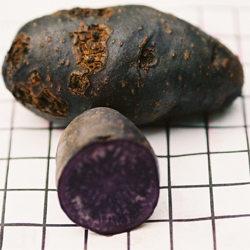
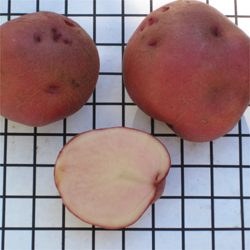
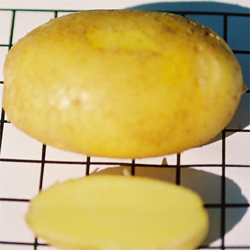
Having been raised on potatoes as a child, and loving them in all the multitude of ways they could be prepared and eaten, you’ll have to forgive me if I go too in-depth with the next crop, but I will. Potatoes have been a favorite of mine for a long while, and only recently had I learned about all the different colors they come in. That’s right, colors! The skins can range from deep bright red to dark purple to yellows to whites and browns, and the flesh is much the same but even brighter. Just take a look at a “Purple Peruvian” fingerling sliced in half, or the earthy mottled-red look of a plump “Huckleberry” potato. Though I haven’t yet tried one (I’m growing them this year), the bright golden-yellow inside of a “German Butterball” looks so tasty I’m tempted to be impatient and dig one up right now. My grandpa wasn’t very familiar with any of these more exotic-sounding varieties, but he did have a particular favorite that actually I hadn’t ever heard of until we talked about them earlier this year. It’s an old but fairly reliable variety of white potato called the “Irish Cobbler.” Grandpa used to plant several hundred pounds of them every year as a child, and was quite fond of them. The potatoes sold in supermarkets anymore are probably all guaranteed to be the one of the standard white potato varieties “Idaho” and “Kennebec,” which both he and I agree are a little too mealy for our tastes. On top of that, most people aren’t aware of how much of a potato’s nutrition lies in the skin, which is generally a bad idea to eat when dealing with “conventionally-grown” potatoes, meaning they’re grown with excessive amounts of chemical fertilizers, pesticides, and who knows what else. All of those chemicals are absorbed right into the soil where – you guessed it – the potatoes are growing, and soaking up all of that grossness right into their skins. Some pesticides now banned by the United States government can still persist in soils today from when they were first outlawed decades ago!

These varieties are just a small sample of the thousands of heirloom potato varieties that were bred and grown by the ancient Native American cultures of the Andes Mountains, where potatoes were first domesticated. Many of the ancient Andean varieties have since been lost to civilization, but many still survive today, and have become increasingly easier to find and grow through the revolution of the internet, along with heirloom variety preserving organizations such as Seed Savers Exchange and others.

Not only are there lots of heirloom varieties out there to experiment with growing, but you can also breed your own NEW varieties of potatoes (and just about any other vegetable for that matter) with their own new sets of characteristics, flavors, resistances, etc. Even though the potatoes we eat are tubers (a type of modified underground stem for storing nutrients), potato plants flower and produce fruit just like all other angiosperms (flowering plants).

Though the potato fruits might look just like miniature tomatoes (which happen to be a close relative of potatoes), potato fruits are extremely toxic and should never, under any circumstances, be eaten.

After a potato has bloomed and been pollinated, a fruit will begin to grow where each flower was. Once these fruits feel tender and ripe like a tomato would when it is ready to be picked, pick them and toss them in a blender with some water for just long enough to get the seeds separated from the rest of the fruit. If you let this mixture sit still for a day in a bit more water, the potato seeds should sink to the bottom while the rest of the fruit matter floats to the top. After separating the seeds and washing them a few times, you will have clean potato seeds. Let these dry on a paper towel and then store them in an airtight container for planting in future years. They should keep for several years.

That’s basically all you need to start growing your very own new varieties of potatoes. Each of those seeds in the potato fruit is genetically unique from any other potato, and from any other seed (even from the same fruit!). With selective harvesting and continued breeding of the most successful (or tasty, disease-resistant, drought-tolerant, huge, etc.) plants, you can successfully breed your very own new and improved potato varieties that have all the qualities you want them to. When you do find that potato that seems to be just the one you’re looking for, you can save some of the tubers from that one to plant next year and grow more and more of that favorite spud. Check out this link for a more in-depth description of how to breed potatoes.

While this description of “vegetable husbandry” was specifically geared towards potatoes, the same general principles apply to many other crops as well. Selective breeding is exactly how we’ve acquired such a vast array of delicious varieties of crops to choose from. Don’t think you need a PhD in crop science and a nice white lab coat to breed new vegetable varieties. Everyday farmers and gardeners have traditionally done it since humans first domesticated plants over 12,000 years ago. Have at it!

Tuesday, June 23, 2009

Trillium Spring Newsletter: Locavores, CSA, more!

Below is a link to the Trillium spring newsletter, featuring a brief review of Barbara Kingsolver's book Animal, Vegetable, Miracle: A Year of Food Life, as well as articles about community supported agriculture (CSA), what it means to be a "locavore," and other useful information.

Check it out here!

http://www.trilliumohio.com/WRSummer2009Newsletter.html


blogger templates